What are BLE Smart Labels? A Complete Guide

The thin, disposable form factor of BLE beacons that brings Bluetooth tracking to parcels and single-use goods.

A BLE smart label is a thin, flexible Bluetooth device that is applied to packaging like an ordinary label, then continuously broadcasts its identity and condition to nearby smartphones, scanners and gateways. This guide explains what BLE smart labels are, how they work, how they compare with barcodes and RFID and where they add value across logistics and cold chain.

What is a BLE smart label?

A BLE smart label is a thin, flexible Bluetooth device built into something that looks and behaves like an ordinary adhesive label. It can be applied to a carton, parcel or product in the same way as a barcode, but instead of waiting to be scanned it continuously transmits a Bluetooth signal that identifies the item and reports on its condition.

At their core, smart labels are Bluetooth beacons. They broadcast small packets of data at regular intervals, carrying a unique identifier, a timestamp and where sensors are fitted, readings such as temperature. Any Bluetooth device within range, whether a smartphone, laptop, handheld scanner or fixed gateway, can detect those broadcasts and forward them to the cloud. Many labels can be read by many devices at once, with no pairing and no manual setup.

What sets smart labels apart from other beacons is how and where they are used. Beacons such as tags and wearables are built for reuse, and tend to be fixed to higher-value assets worth retrieving or recharging. A smart label brings the same connected intelligence to goods that are shipped, consumed or distributed in large volumes, where recovering a reusable device would not be practical or economic.

The result is packaging that doubles as a data source. Each label gives an item a digital identity and a continuous record of where it has been and how it has been handled. That is particularly valuable in regulated sectors such as healthcare and food logistics, where auditable, item-level evidence matters.
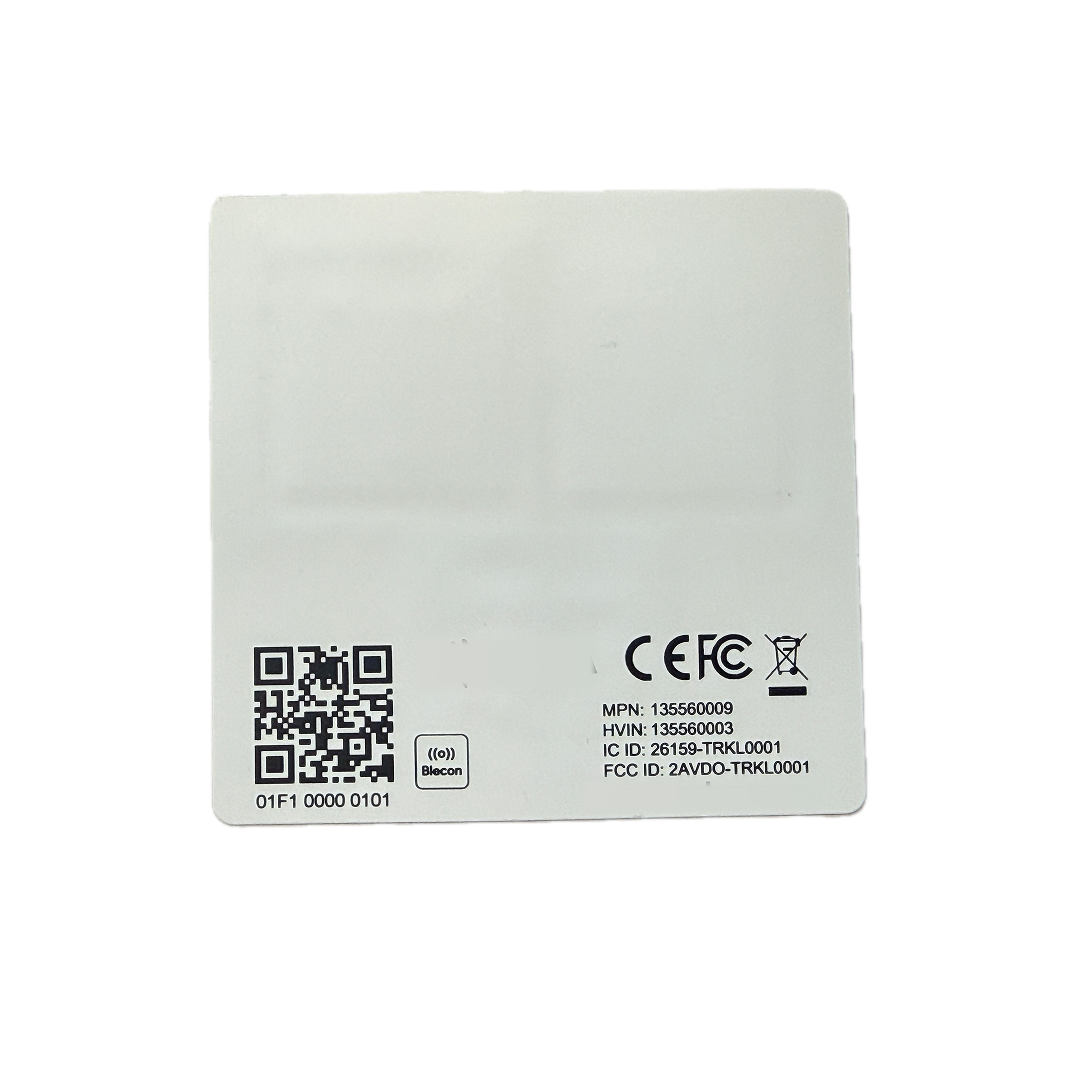
TL05-BCN Tag - Bluetooth tracking and temperature sensing in a single-use BLE Smart Label.

How do BLE smart labels work?

A smart label is designed to slot into the way goods are already handled. It is peeled, activated as it is applied and stuck onto a carton, pallet or product. From that moment it works on its own, broadcasting a short Bluetooth signal at regular intervals. There is no reader to install, no line of sight to maintain and no pairing step to complete. Any Bluetooth device that passes within range, whether a handheld scanner, a delivery driver's phone or a fixed gateway, picks up the broadcast and forwards it to the cloud. There, the label's identity and any sensor readings become a continuous record of where the item is and how it has been handled. Because the same broadcast can be heard by many devices, coverage builds naturally wherever everyday Bluetooth devices are already present.
 
What makes that possible is a complete wireless device hidden inside a label less than a millimetre thick.

Bluetooth Low Energy SoC.
A low-power system-on-chip that sends short packets of data, then drops back into deep sleep between transmissions, drawing only microwatts so it can run for weeks or months.
 
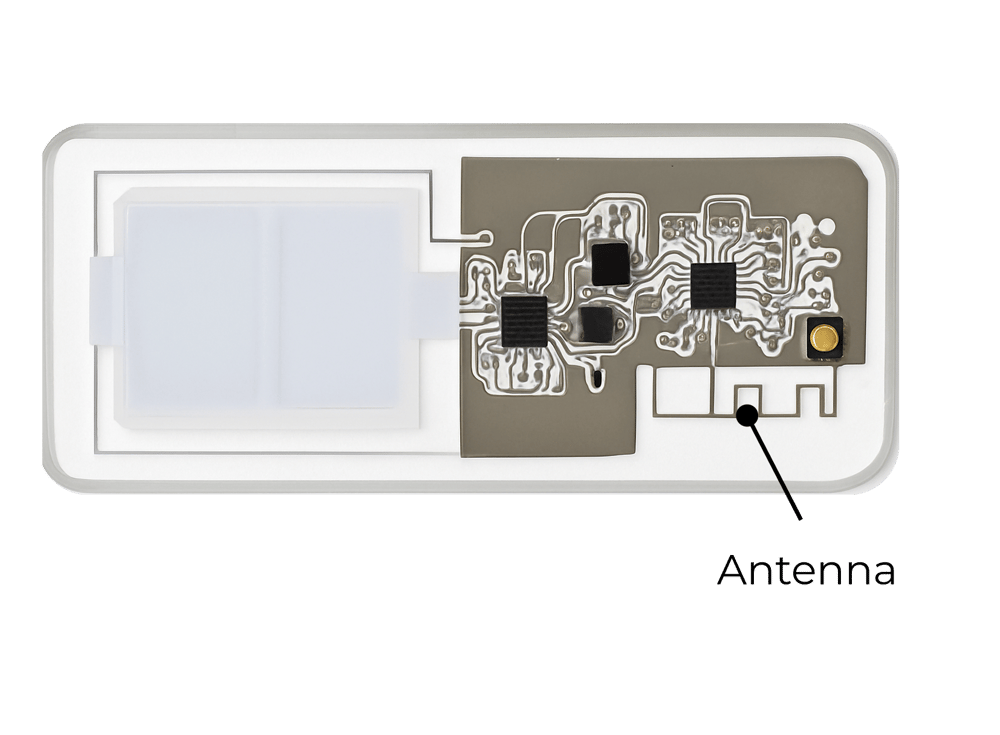
Printed antenna
Conductive ink printed onto a flexible backing in place of a rigid circuit board, tuned for the 2.4 GHz band so it still radiates well when the label is curved or stuck to an awkward surface.

Printed zinc-based battery
An ultra-thin, non-lithium power source that is safe to send by air and to throw away with ordinary packaging waste.

Optional sensors
Where condition matters, the label can add temperature, humidity, light or motion sensing, each drawing only tiny amounts of current.

Because every part is printed or laminated into a thin, flexible strip, the finished label bends, sticks and ships like any other label, while behaving like a networked sensor.
molex-printed-antenna-iot-pcb-design-closeup

What makes BLE smart labels possible?

The idea of a thin, wireless label that can sense and communicate is not new. Engineers have worked towards it for more than a decade. What has changed is that the pieces needed to build one at scale and at a sensible cost, have finally matured at the same time. Three advances in particular moved smart labels from prototype to commercial reality.

Smaller, lower-power silicon

Bluetooth Low Energy chips now pack the radio, timing and sensor connections into a few square millimetres and run on microwatts. That is low enough to be powered by a printed battery and small enough to laminate inside a label.

Printed, flexible, safe power

Zinc-based batteries can be printed straight onto a flexible backing, supplying enough energy for periodic Bluetooth transmissions without using lithium. They are safe to send by air and to throw away with ordinary waste, which is what makes a single-use label practical.

Roll-to-roll manufacturing

Conductive inks and flexible substrates let the circuit, antenna and battery be printed in the same continuous process already used to make ordinary labels and packaging. Smart labels can be produced alongside existing materials, so volumes can grow without building new factories.


BLE smart labels vs barcodes and RFID

Smart labels are the latest step in a long line of ways to give a physical item a digital identity. Each generation solved a problem the last one left behind and smart labels build directly on barcodes and RFID rather than discarding the idea behind them.

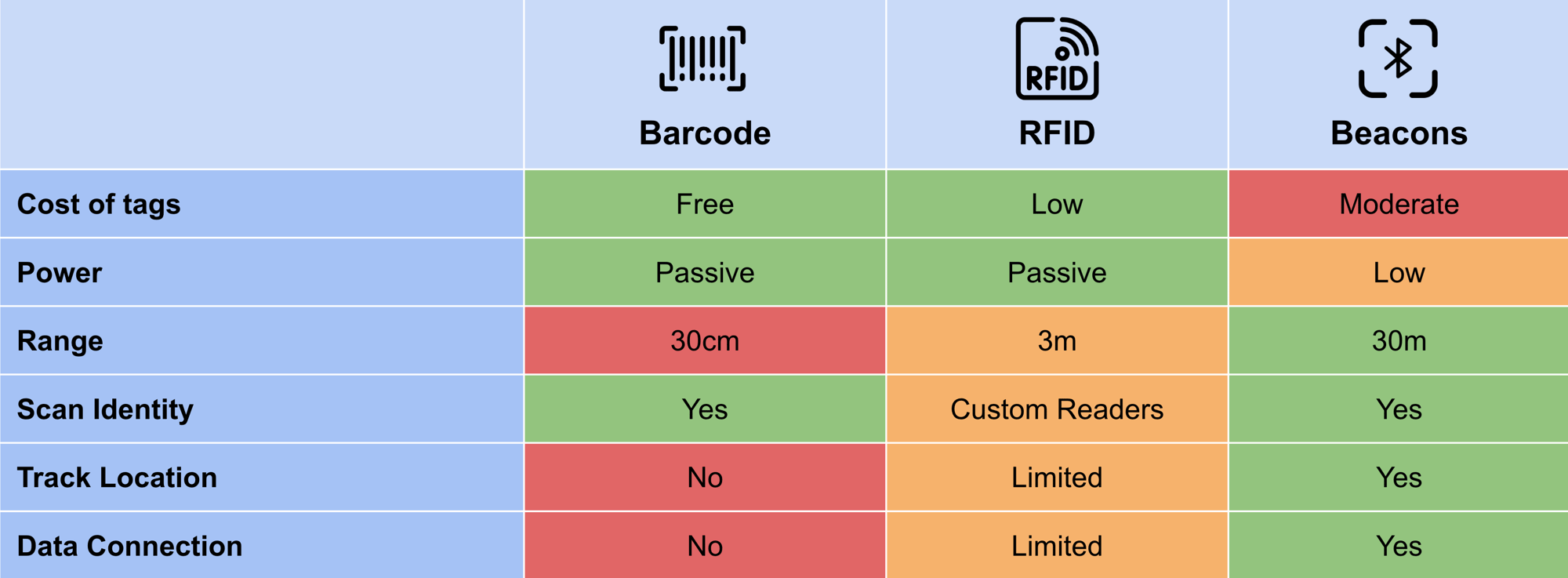
Barcodes gave goods their first cheap, printable digital identity and they are still unbeatable on cost. Their limit is visibility. A barcode only tells you anything at the moment it is scanned, so between checkpoints the item goes dark.

RFID removed the need for line of sight and let goods be read automatically and in bulk as they pass a reader. The trade-off is infrastructure. Passive RFID needs specialised readers and can struggle around liquids and metal, while active RFID adds battery and cost, which tends to confine it to controlled sites such as warehouses and distribution centres.

BLE smart labels take the next step. They keep the peel-and-stick simplicity of a barcode and the automatic, no-line-of-sight reading of RFID, but drop the proprietary reader entirely. Because they use Bluetooth, any smartphone, laptop, scanner or gateway already in the operation can receive them, so coverage extends without new hardware. And because they can carry sensor data as well as identity, they report condition as well as location.

BLE smart labels vs barcodes and RFID comparision table

What are BLE smart labels used for?

The arrival of BLE smart labels marks a shift in how enterprises capture and use physical-world data. Until now, wireless visibility has depended on reusable hardware: devices that must be charged, maintained and returned. That model works, but not where the tracker itself is not wanted back, or where retrieval adds cost, complexity or risk to the operation.

Smart labels change that. Their printed, non-lithium design means they can be safely disposed of, or recycled with the packaging, eliminating the need for return logistics. This unlocks a new category of connected applications that were previously impractical: temporary, lightweight, low-cost devices that still deliver secure, verifiable data.

Cold Chain Monitoring

A single-use label with an onboard temperature sensor is applied at dispatch and travels with the goods, building a temperature record through every handoff. It suits one-way cold shipments where the packaging is discarded at delivery, such as fresh produce, short-shelf-life food, parcel-level pharma and vaccines and one-way frozen deliveries. See cold chain monitoring.

Inter-site shipping

Applied to a carton or crate at dispatch, a single-journey label follows a shipment from origin to destination, recording parts, assemblies and work in progress as they move between sites. It fits one-way moves where the item stays put or the packaging is discarded at the destination. See inter-site shipments.


Download the Definitive Guide to BLE Smart Labels

This page covers the essentials. The Definitive Guide to BLE Smart Labels goes deeper: how Smart Label Beacon Networks secure and route the data, how labels sit alongside other Bluetooth formats at enterprise scale and where the technology is heading with the emerging Ambient IoT. Discover the next evolution in connected visibility, built on Bluetooth Low Energy and printed electronics.

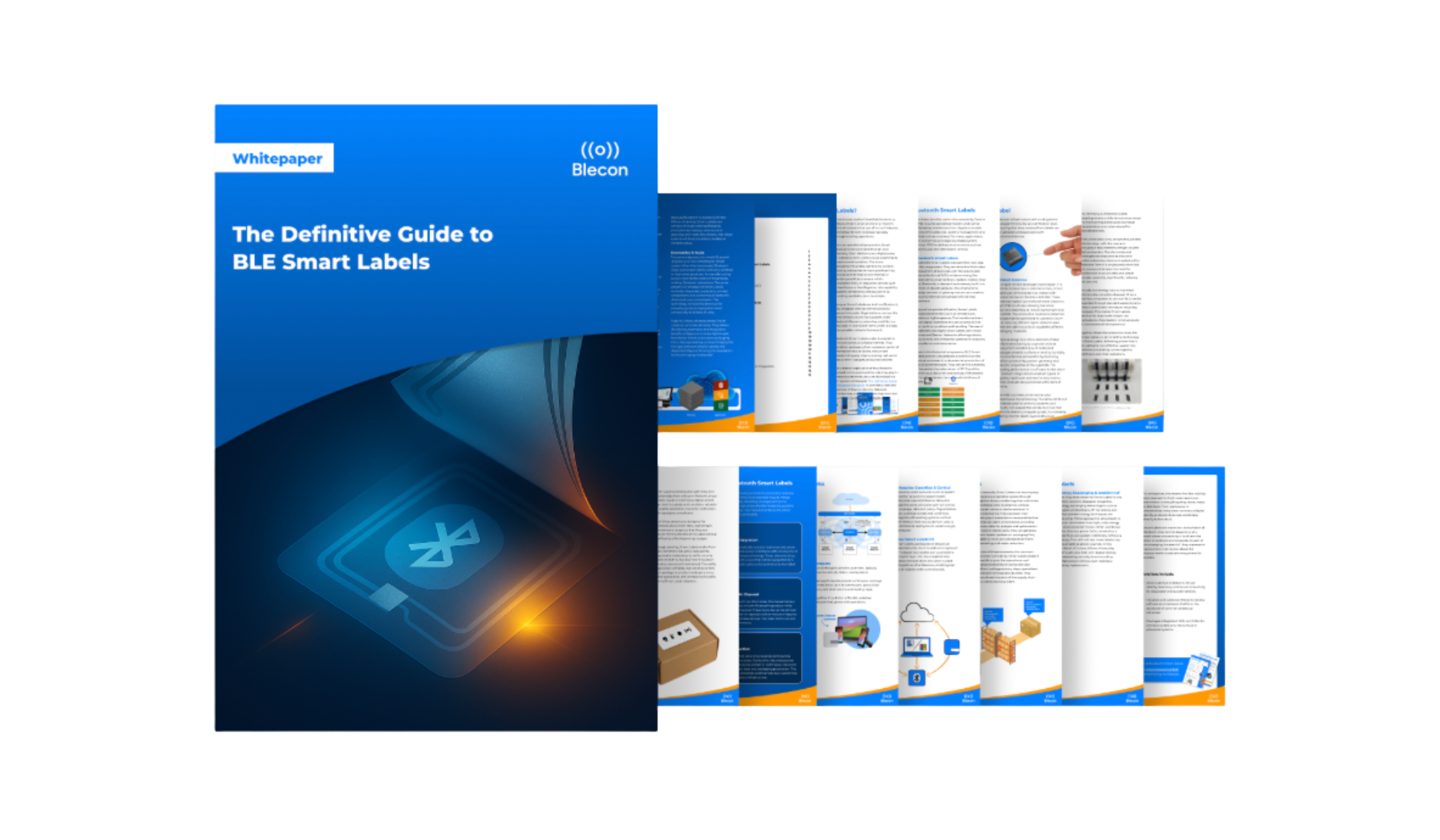
 

The Definitive Guide to BLE Smart Labels
 

Explore the Blecon Label Tag

The TL05-BCN is a BLE smart label you can put to work today. Less than a millimetre thick, it peels, sticks and starts tracking on placement, with an onboard temperature sensor and a non-lithium, air-safe battery that is disposed of with the packaging. Its 90-day lifetime suits one-way shipments and cold-chain journeys. Each label connects through the Blecon Network, using the frontline devices already in your operation to carry secure location and sensor data into the cloud.

→ Explore the TL05-BCN BLE Smart Label


TL05-BCN Tag - Bluetooth tracking and temperature sensing in a single-use BLE Smart Label.