What are Bluetooth Beacons?

A guide to BLE Beacon technology; what beacons are, how they work, the different types and formats and where they're used.

A Bluetooth beacon is a small wireless device that makes a physical object, place, or person digitally visible. It broadcasts a short signal over Bluetooth Low Energy (BLE) that nearby phones, gateways, and other devices can detect to determine location, proximity, or condition. Beacon technology now underpins everything from indoor navigation and retail to large-scale asset tracking and condition monitoring.

What is a Bluetooth Beacon?

A Bluetooth beacon is a small wireless device that makes a physical object, place, or person digitally visible and a source of real-world data. It does this by transmitting small, low-power signals over Bluetooth Low Energy (BLE), which nearby devices, smartphones, laptops, scanners, or gateways, can pick up.

At its simplest, a beacon advertises a unique identifier — in effect saying "I am here" — so it can be spotted. Many also report state, such as battery level, temperature or other sensor readings. Newer, next-generation beacons go further: rather than only broadcasting, they connect and synchronise, reporting what they've seen since they were last in range. These support secure two-way communication, uploading stored data, syncing time and receiving updates, with cryptographic identity and encryption to keep that data trustworthy.

What sets a beacon apart from everyday Bluetooth devices like headphones is that it needs no pairing. One beacon can be seen by many gateways and one gateway can handle many beacons at once. And because BLE draws so little power, beacons can run for years on a coin-cell battery or in printed and disposable formats thin enough to apply like a label.


Blecon Asset Tracking Tags - Classic, micro, ble smart label (1)

How Bluetooth Beacons Work

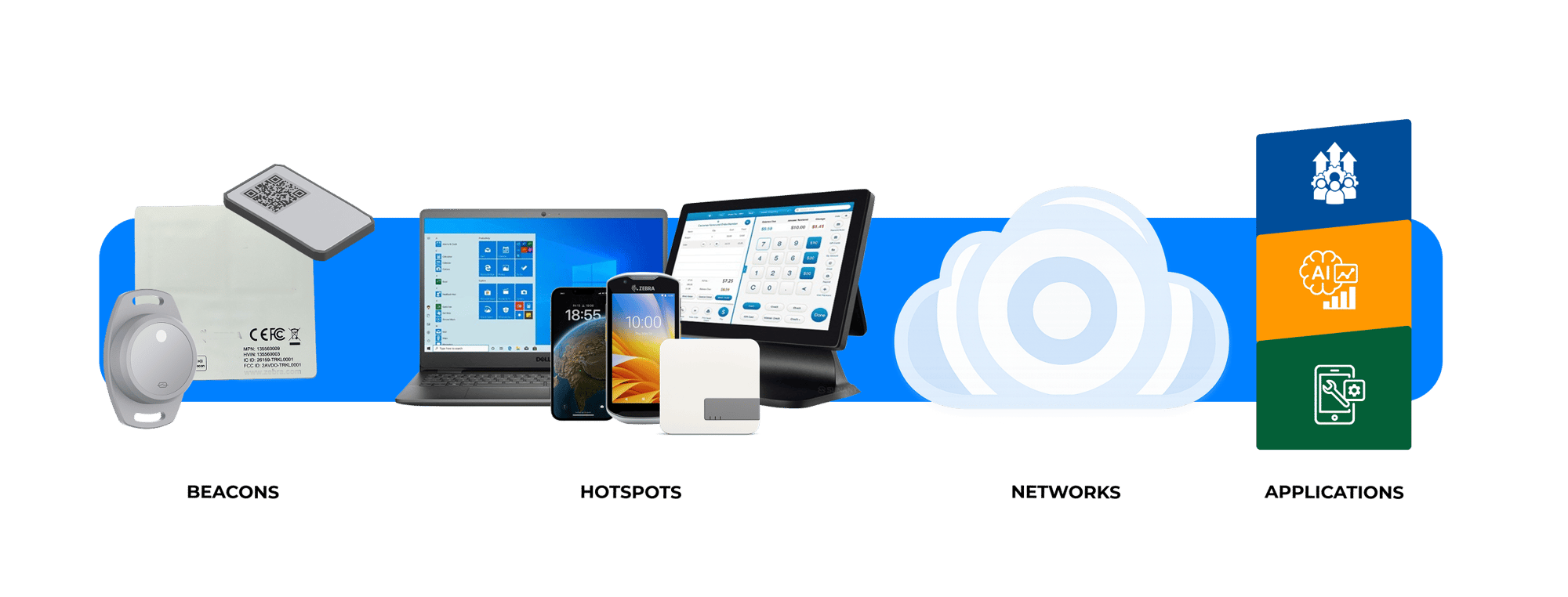
A beacon does the simple part, it broadcasts. The system around it does the rest: collecting the signal, working out what and where it is and turning that into something useful. The full cycle takes four steps.

1. Broadcast. The beacon transmits a small advertising packet several times a second over BLE. The packet carries a unique identifier and, on sensor beacons, readings such as temperature or motion. It's sent to no device in particular; the beacon simply puts the signal into the air.
 
2. Detect. Nearby gateways, a fixed unit, or a phone, tablet or handheld scanner carried by staff, listen for these packets. No pairing is needed. When a gateway hears a beacon, it reads the identifier and notes how strong the signal is.
 
3. Resolve and locate. The gateway forwards what it heard to a network or cloud service, which matches the identifier to the right asset and uses signal strength to estimate how close the beacon is. With reports from several gateways the system can work out a position, even indoors, where GPS can't reach.
 
4. Act. The resolved data flows into an app or business system, which decides what it means and responds, placing the asset on a live map, raising an alert when something leaves a zone or a temperature breaches a limit, or logging an arrival. Because the cycle repeats continuously, a beacon is detected almost the moment it comes into range and its absence noticed when it leaves.
This runs on Bluetooth Low Energy, designed for exactly this kind of brief, low-power transmission in the 2.4 GHz band that Bluetooth already uses. Instead of holding an open connection, BLE wakes, sends a tiny burst of data and sleeps again. This is how a beacon lasts for years on a small battery and why one gateway can serve many beacons as they roam past, more like a mobile network than a paired device. Newer beacon formats add a return path: when out of coverage they store readings, then open a short, secure connection to sync the backlog, confirm receipt, or accept a configuration or firmware update once a gateway is back in range.


BEACONS HOTSPOTS NETWORKS APPLICATIONS HOTSPOTS NETWORKS APPLICATIONS

BLE beacon form factors

Beacons share the same core electronics, a BLE radio, a battery, sometimes a sensor, but they're packaged in very different ways depending on the job. Broadly, some are fixed in place while others travel with an asset or a person.

Tags

A beacon tag, also called an asset tag, is attached to something that moves: a pallet, a tool, a piece of medical equipment. Tags are compact and rugged, often carrying sensors for motion or temperature. Apple's AirTag made the idea familiar to consumers; enterprise versions are built for industrial and healthcare use.

Wearables

Wearable beacons are designed for people rather than assets, in the form of badges, lanyards, wristbands, or clip-on devices. In workplaces they support safety and access control by showing where staff are; in healthcare they can track patient movement or detect falls. Comfort and battery life for all-day wear are the key design constraints.

Labels/Stickers

Thin, lightweight beacons in the form of stickers or smart labels are a fast-growing category. Powered by small flexible batteries and often disposable, they're applied as easily as a barcode but give continuous visibility instead of needing a manual scan. They're used for one-way tracking in logistics and mark the next step from barcodes and RFID to Bluetooth.

Embedded

Beacon functionality can also be built into a larger product, so there's no separate tag at all. Apple's AirPods are a familiar example, earphones that also broadcast for Find My, while in healthcare connected inhalers embed a beacon to log usage automatically. Embedded beacons are common in regulated, long-lifecycle equipment where identity and condition monitoring matter.

Beacon Formats: iBeacon, Eddystone, and NeoBeacon

A beacon's format is the language it broadcasts in,  it defines how data is packed into each Bluetooth signal and how receiving devices should read it. The format determines what a beacon can do, how widely it's understood and how secure it is.

iBeacon
Introduced by Apple in 2013, iBeacon was the first widely adopted format. Its structure is simple: a UUID groups related beacons, with major and minor values pinpointing a zone or a specific point. That simplicity, plus built-in support in iOS, made it dominant in the early years and it cemented the beacon's role as a location anchor for proximity-triggered apps in retail, events and venues. It remains common today, though it offers no built-in security.
 
Eddystone
Google's 2015 answer was an open, more flexible format with several frame types: UID for identity, URL for linking to web content without an app, TLM for telemetry like battery and temperature and EID, an ephemeral ID that rotates to protect privacy. Google's marketing focus never quite matched the industry's need for reliable tracking, but Eddystone's ideas, telemetry and rotating identifiers, shaped the formats that followed.
 
Proprietary
As enterprise use grew, vendors added proprietary formats to fill gaps in telemetry and management, useful but hard to interoperate. 
 
NeoBeacon
NeoBeacon is a next-generation secure beacon format, developed by Blecon, built for the demands iBeacon and Eddystone can't meet. Where a hospital needs an infusion pump to prove not just where it is but how and when it was used, NeoBeacon adds cryptographic identity that can't be spoofed, encrypted and rotating identifiers for privacy, flexible payloads carrying both ID and sensor data, and secure two-way communication to sync with the cloud. Unlike the formats before it, NeoBeacon doesn't just announce itself, it can confirm its data was received, log readings offline and update over the air.
 
 
beacon-format-capabilities-chart-ibeacon-eddystone-proprietary-blecon-comparison

What are Bluetooth beacons used for?

Beacons earn their place by turning physical operations into a continuous stream of data; showing where things are, how they're being used and what condition they're in. Their first mainstream use was retail proximity marketing: triggering an offer on a shopper's phone as they passed a display. That grew the technology, but the lasting value turned out to be operational. Across every sector, the same handful of needs recur: knowing where assets are, monitoring their condition and proving, for audits, regulators, or insurers, that things were handled correctly.

Logistics and supply chain

Tracking pallets, cages and returnable transport items through warehouses, across inter-site shipments and in transit; cutting losses, speeding handling and creating an auditable record. Sensor beacons add condition data like temperature for cold chain monitoring and high-value shipments; air-cargo operators, for instance, track large fleets of containers across hundreds of airports.

Healthcare

Locating equipment across a hospital, monitoring patient or staff movement and proving that drugs and devices were stored and used correctly, turning visibility into compliance evidence. Hospitals use beacons to find equipment fast and cut time wasted searching.

Manufacturing

Tracking tools and equipment, containers and work in progress on the factory floor, and feeding sensor data into predictive maintenance. Manufacturers such as aircraft makers track tools and assemblies across large sites to keep workflows on schedule.

Retail

Beyond the early marketing experiments, retailers now use beacons operationally; tracking stock and customer flow, supporting checks in perishable zones, and, with smart labels, following items from supply chain to shelf to returns, improving inventory accuracy and traceability for recalls.

Bluetooth beacons vs other tracking technologies

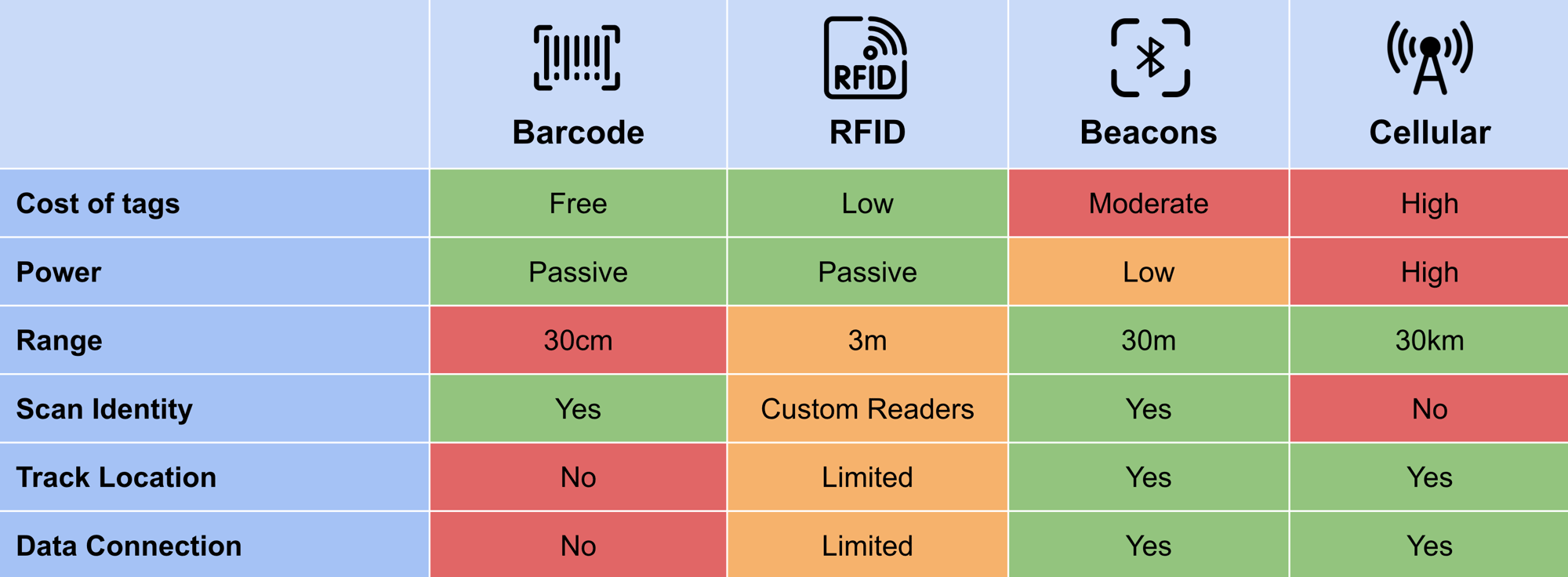
No single technology wins at everything, each trades off cost, power, range and how much data it can carry. Bluetooth beacons sit in a useful middle ground: cheaper and lower-power than cellular or GPS, but far more capable than a barcode label.

vs Barcodes
A barcode is effectively free and needs no power, but it only holds a fixed identity and must be deliberately scanned at close range, it can't report location or send data on its own. A beacon broadcasts continuously, so tracking happens automatically rather than one manual scan at a time.
 
vs RFID.
RFID tags are cheap and battery-free, but they only work at close range and need dedicated readers at fixed checkpoints, ideal for structured workflows like portal or conveyor scanning. Beacons cost a little more, but they're detected across a whole room or site by the frontline devices already in use and they can carry sensor data such as temperature that passive RFID can't. RFID suits assets that pass defined points; beacons suit assets that move freely and must stay visible.

vs GPS
GPS gives absolute location anywhere outdoors, which makes it the right choice for vehicles and long-haul containers. But it needs a clear view of the sky, draws far more power and usually relies on a cellular link to report back, costly to fit to every item. Beacons work indoors as well as out, at short-to-medium range, on a fraction of the power. GPS is best for high-value assets on the move; beacons are best for visibility at scale and indoors, where GPS can't reach.
 
 
bluetooth-beacons-vs-barcode-rfid-gps-range-power-capability-chart

Download The Definitive Guide to Bluetooth Beacons

The Definitive Guide to Bluetooth Beacons covers how beacons work, the full range of devices and formats, the networks that connect them, and applications across logistics, healthcare, manufacturing, and retail, plus where the technology is heading next. It's the complete reference for business and technical leaders evaluating beacons at scale and it goes well beyond what fits on this page.
Definitive Guide to Beacons WP Image Transparent

Explore Blecon Tags

Now you know how beacons work here's how Blecon puts them to work. Blecon turns BLE beacons into real-time asset tracking and condition monitoring, using NeoBeacon, our secure beacon format, read by the frontline devices your team already carries with Blecon Agent. 

  • The SH01-BCN: compact and peel-and-stick, for tracking at high volume.
  • The TL05-BCN: a thin and disposable smart label, for single-use tracking of shipments.
  • The L02S-BCN: a logging tag with a full sensor suite, for assets that travel through coverage gaps.

Explore all Blecon Tags

Blecon Asset Tracking Tags - Classic, micro, ble smart label (1)